Energy & Power Solutions
Energy & Power Solutions
Origin Quantum combines quantum machine learning, quantum algorithms and hybrid quantum-classical computing to support algorithm development, model validation and applications for power forecasting, state analysis and optimization research.
Overview
Modern power systems demand efficient computation, accurate forecasting and operational analysis for renewable output, load forecasting, power flow and fault diagnosis. Multiple data sources, complex temporal relationships and large network models increase modeling and computing demands.
Origin Quantum combines quantum machine learning, quantum algorithms and hybrid quantum-classical computing to support algorithm development, model validation and applications for power forecasting, state analysis and optimization research.

Industry Challenges

Variable Renewable Output
Wind and solar output fluctuate with weather, creating uncertainty and raising demands on power forecasting and grid dispatch.
Complex Load Dynamics
Weather, user behavior and production affect demand, requiring models to handle long-term dependencies, coupled variables and unusual fluctuations.
Growing Grid Analysis Demands
Larger grids and increased renewable integration require power flow analysis of more complex networks and operating conditions.
Demanding Fault Detection
Diverse grid data must distinguish faults from normal operation to support anomaly analysis and response.
Constrained Storage Planning
Storage siting and sizing involve grid structure, load distribution, renewable output and construction conditions, creating a constrained, multi-objective problem.
Solution Architecture
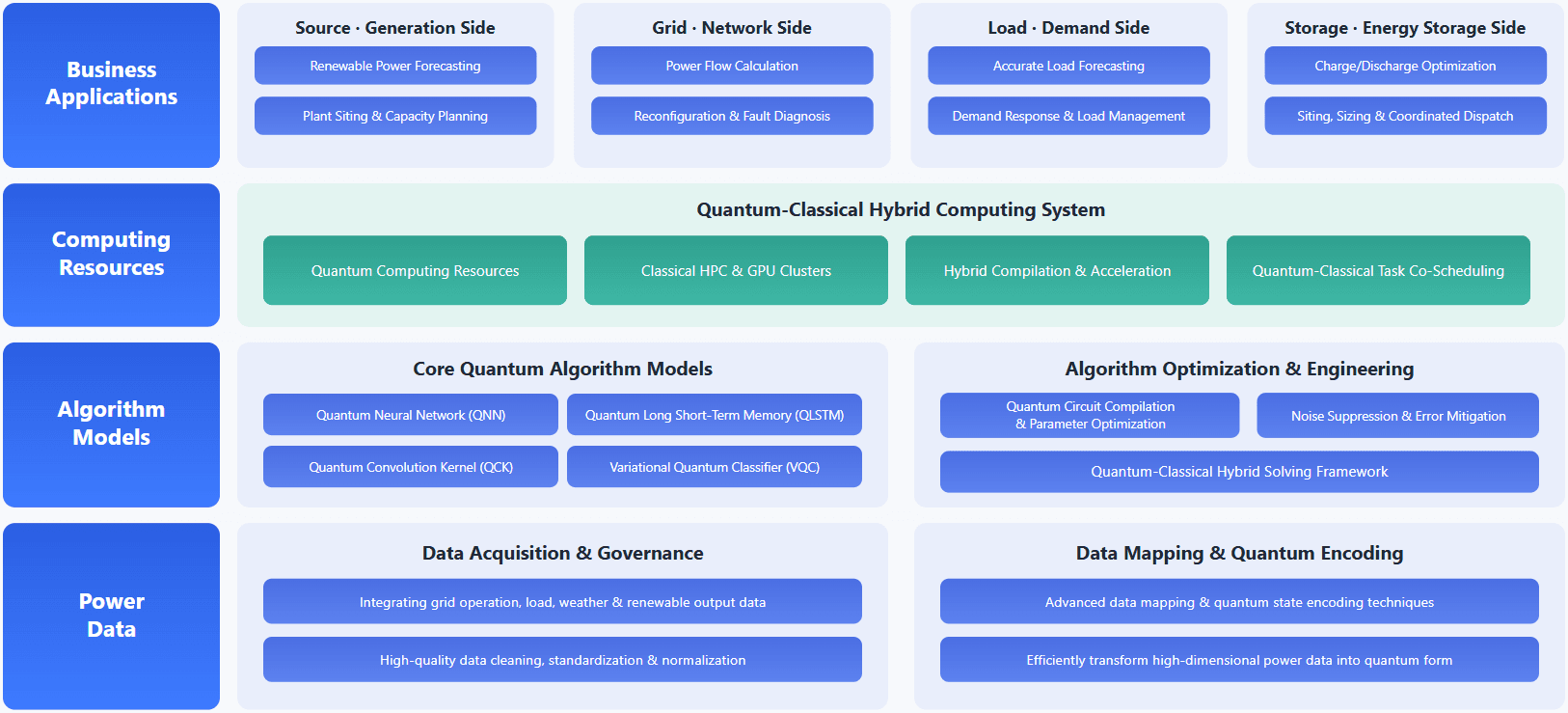
An architecture spanning power data, algorithm models, computing resources and business applications.
Develop and validate quantum models (QNN, QCK) for power tasks via data preprocessing and feature engineering. Superconducting quantum computers, simulators and integrated quantum–HPC resources support algorithm research and applications.
Key Advantages

From Algorithms to Applications
Connect models, development frameworks, platforms and computing resources around power-sector needs, providing a complete research toolkit.

Algorithms for Diverse Tasks
Quantum LSTM networks, attention models and solvers support forecasting, state analysis and optimization research.

Multiple Computing Options
Choose quantum simulation, classical HPC or quantum hardware for computation and validation based on model features and task size.

Evaluation on Real Data
Assess forecast errors, operational stability, computing costs and suitability against power data characteristics and business metrics.
Core Products and Capabilities
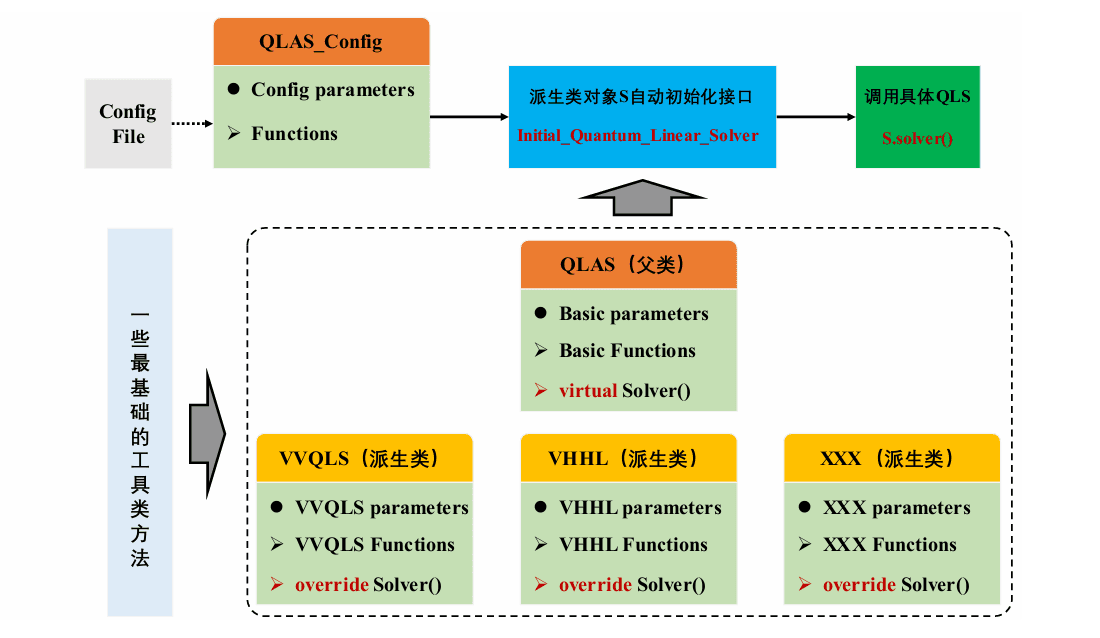
Quantum Computing Linear Algebra Solver
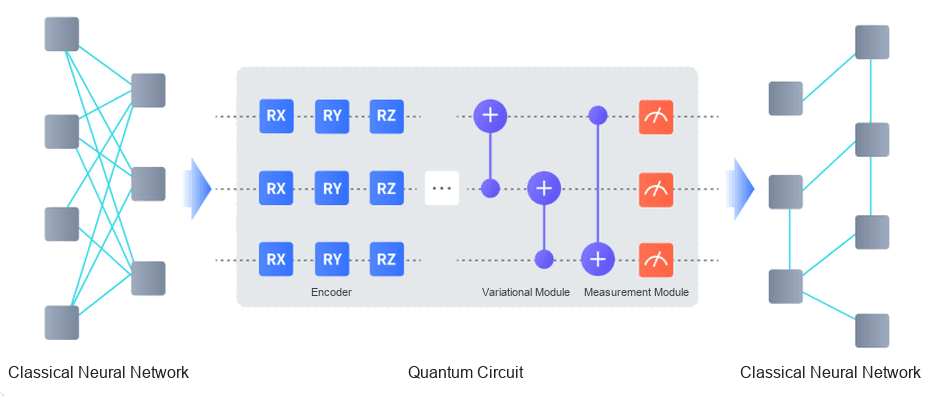
Quantum Machine Learning SDK
Applications
Solar Power Forecasting
Weather-driven solar output is nonlinear and variable, requiring forecasts based on historical power and weather data.
Quantum LSTM and hybrid models support short-term forecasting, combining temporal and feature analysis to compare errors and stability and inform supply–demand analysis.
Grid Load Forecasting
Weather, user behavior and production affect load, requiring analysis of time patterns and external variables.
Quantum spatiotemporal attention models combine historical load and weather data for multivariate forecasts and validation across operating conditions.
Power Flow Analysis
Grid planning and operation require bus voltage and power calculations, with larger networks increasing computing demands.
Combine Newton–Raphson and quantum linear solvers for hybrid power flow research, evaluating results against network size, accuracy needs and computing conditions.
Fault Diagnosis
Grid anomalies need prompt detection and localization, while complex conditions demand stronger data analysis and classification.
Quantum feature extraction and classification models support fault recognition and abnormal-state analysis for diagnostic research.
Collaboration Partners






Consultation Process
Consultation
Define power-sector needs, data and evaluation metrics.

Assessment
Select models, computing environments and validation scope.
Joint Validation
Train models, test cases and compare results.
Implementation
Develop applications or platforms based on validation.

Interested or have questions about our Energy & Power solutions?
You can reach out to us for a free consultation by submitting an online inquiry or adding our assistant. We are here to provide you with dedicated support and answers.