OriginQ QCFD
OriginQ QCFD
Quantum-Driven Fluid Simulation Breakthrough Accurate Modeling for Cross-Domain Flow Dynamics
Introduction
OriginQ-QCFD is a quantum-powered computational fluid dynamics software that leverages quantum parallelism to overcome performance limitations in traditional simulation methods.
By enabling high-fidelity modeling of fluid systems, it finds applications across aerospace, energy, environmental, and automotive sectors. QCFD accelerates fluid analysis workflows while delivering predictive accuracy.
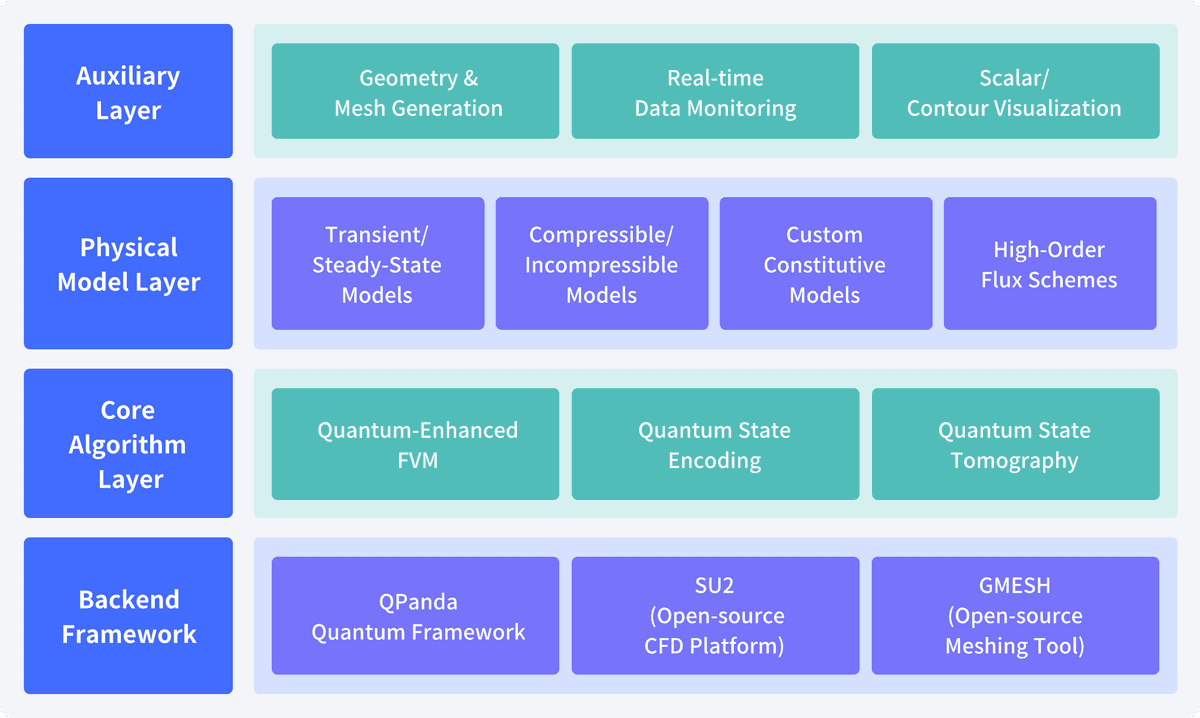
Usage Mode
| Usage Mode | OriginQ-QCFD(Client) | OriginQ-QCFD(C++ Package) |
|---|---|---|
| Supported Systems | Windows | Linux |
| Installation | Contact Us | |
| API Extensions | - | ✓ |
| Programming Skills | - | Quantum Basics Required |
| Tutorial | Learn More > | Learn More > |
Functional Modules
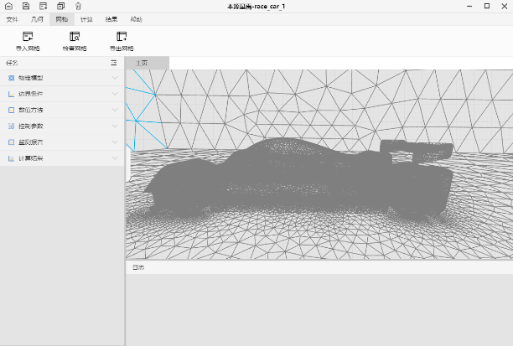

Mesh Generation & Import
· Supports mainstream mesh file formats
· Integrated geometry construction & mesh generation in Windows
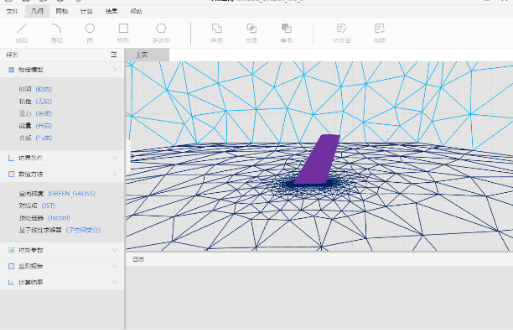
Physical & Numerical Models
· Transient/Steady-State solving
· Compressible/Incompressible models
· Custom fluid constitutive models
· 1st/2nd-order flux schemes
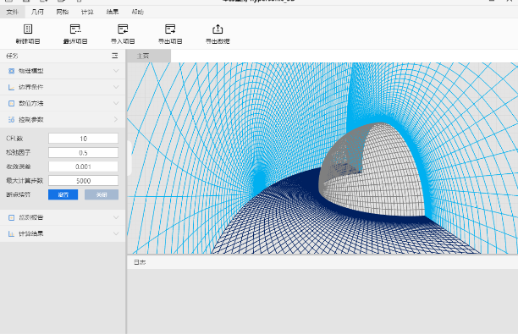
Distributed Computing & Checkpoint
· Distributed computing acceleration
· Checkpoint restart for large-scale tasks
Features

Quantum linear solvers
· Subspace HHL algorithm
· Subspace variational algorithm
Multi-preconditioners
· DIAGNOAL_SCALING
· STATIC_SPAI
· DYNAMIC_SPAI
· Jacobi
Multi-fluid properties
· Compressible and incompressible flows
· Steady and unsteady flows
· Inviscid, laminar and turbulent
(Supports 2D and 3D simulation and result rendering)
Multiple simulation backends
· Superconducting quantum computer(coming soon)
· Local Host
· Clusters
· Support checkpoint resumption
Application Examples

Low-speed flow
Flow with Mach number less than 0.3 belongs to the category of incompressible flow.
 2D examples
 3D examples
Transonic flow
Transonic flow is generally defined as flow with Mach number between 0.8 and 1.3, which belongs to the category of compressible flow.
2D examples3D examples
Hypersonic flow
Hypersonic flow is generally defined as flow with Mach number greater than 5, which belongs to the category of compressible flow.
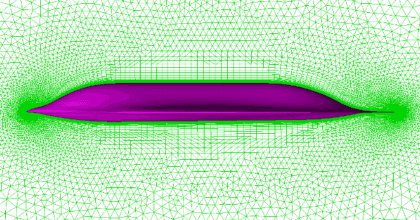
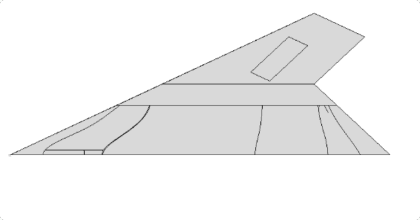
2D examples3D examples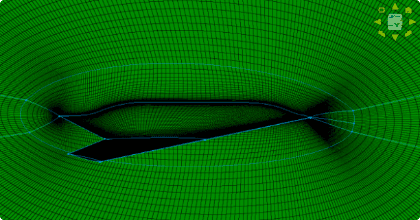
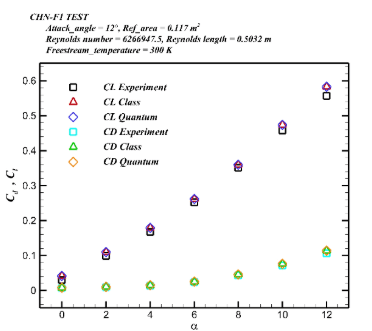
Calculation Results of Lift and Drag Coefficients
Applications

Aerodynamics Design
QCFD can realize efficient simulation in the process of aerodynamic optimization design, improve the aerodynamic layout of the aircraft, and improve the lift-to-drag ratio of the aircraft.

Marine Exploration
In the field of navigation, the drag of ships can be reduced with the help of QCFD analysis and optimization.

Civil Engineering
In terms of people's livelihood projects, QCFD design can be used to improve the structural safety of buildings and optimize indoor air heating.
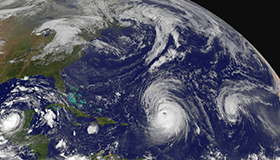
Weather Forecast
Based on the acceleration of quantum computing, QCFD can improve the efficiency and accuracy of weather forecast.